
Last reviewed: April 2026
✔ Fact-checked by the Indian Law & Property Team at Whytecroft Ford
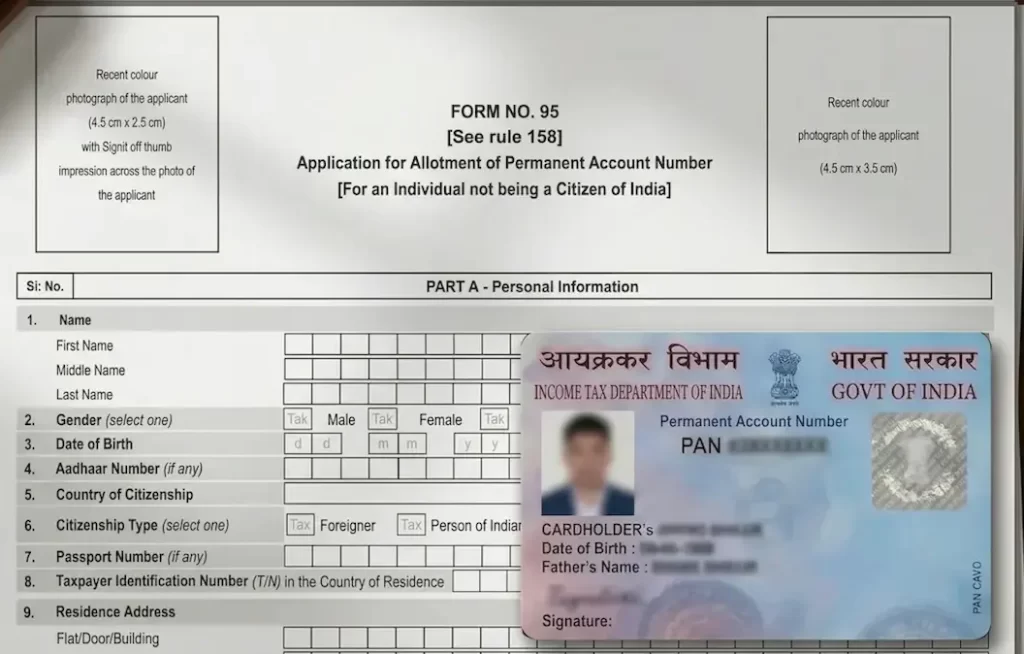
On April 1, 2026, the Indian Income Tax Department, under the Ministry of Finance, initiated the full implementation of the PAN Card 2.0 Project. This represents a comprehensive business process re-engineering of the Permanent Account Number system. For Overseas Citizens of India (OCI) and Foreign Nationals, the update introduces a more specialised compliance framework under Rule 158 of the Income-tax Rules, 2026.
The primary shift involves the retirement of the generic Form 49AA in favour of Form 95, designed specifically for individuals who are not Citizens of India. Within this update, we examine what has changed.
Official CBDT & Government Regulatory Summary
What is PAN Card 2.0?
According to the Central Board of Direct Taxes (CBDT), PAN Card 2.0 is a technology-driven transformation of taxpayer registration services. It features a Unified Portal for all PAN/TAN services, high-density dynamic QR codes for real-time offline verification, and a durable PVC card format.
What is the new form for OCI and Foreign Citizens?
Under Rule 158 (2026), Foreign Citizens and OCI cardholders must now use Form 95 for PAN allotment. This form replaces the erstwhile Form 49AA and mandates disclosure of a Taxpayer Identification Number (TIN) from the applicant’s country of residence, a key update not present in PAN 1.0.
How to Apply for a New PAN Card 2.0?
For the full application process, see our complete guide to applying for a PAN card from the UK.
Is a National Insurance Number mandatory? A Major Update.
Yes. S.No 8 of Form 95 explicitly requires the Taxpayer Identification Number (TIN) or functional equivalent (e.g., National Insurance Number in the UK or SSN in the USA) for all Foreign citizen applicants to align with international tax transparency standards. This is a major update in PAN 2.0, which was not the case in PAN 1.0.
Key 2026 Changes: A–Z Form 95 Compliance at a Glance
The 2026 guidelines have introduced a higher threshold for data accuracy and security. If you are looking to understand what is new pan card 2.0, here is the operational breakdown:
- A: Aadhaar Capture – While not mandatory for non-residents, Form 95 includes a field to capture Aadhaar if the applicant possesses one.
- C: Citizenship Sub-Types – You must now select between Foreigner, Person of Indian Origin (PIO), or Overseas Citizen of India (OCI).
- F: Father’s and Mother’s Name – Providing both parents’ names is now a mandatory requirement on the form, facilitating clearer lineage tracking.
- I: Initials Prohibition – Per official Note 1 of Form 95, names must be provided in full. Abbreviations or initials are no longer accepted unless they appear as such on an existing Aadhaar card.
- M: Mandatory PoB – Proof of Date of Birth is a strictly mandatory separate document category. While a passport is often used, it must be explicitly designated as the PoB in the application.
- Q: QR Code Verification – The hallmark of what is pan 2.0 card security is the dynamic QR code on the physical PVC card, which stores encrypted real-time data for instant KYC checks by banks.
- T: TIN Requirement – The Taxpayer Identification Number (e.g., UK NI Number) is a compulsory field to ensure alignment with the Common Reporting Standard (CRS).
How to Acquire, Upgrade, and Download PAN 2.0
If you are an existing cardholder or a new applicant, the following procedures govern how to apply for new pan card 2.0 and manage your non-Indian national digital identity:
How to upgrade PAN Card 2.0
Existing PAN holders do not need a new number. To receive the new secure hardware, you can upgrade pan card 2.0 by selecting the “Reprint of PAN Card” or “Changes/Correction” link on the portal. This will trigger the issuance of the new PVC card with the dynamic QR code.
How to download PAN Card 2.0
Once your application or upgrade is approved, you can download pan card 2.0 in its digital “e-PAN” format. This is usually available via a secure link sent to your registered email within 7–10 days (or as little as 2 hours for certain e-KYC enabled applications).
PAN 1.0 vs. PAN 2.0 Comparison
| Feature | Legacy PAN (Pre-2026) | New PAN Card 2.0 |
| Primary Form (Foreign) | Form 49AA | Form 95 |
| Card Material | Laminated Paper | Durable PVC |
| Verification | Static / Manual | Dynamic QR Code |
| Foreign Tax ID (TIN) | Often Optional | Now Mandatory |
| Unified Portal | Multiple (Protean/UTI) | Single Unified ITD Portal |
Frequently Asked Questions
Yes. Existing PAN numbers remain valid under PAN 2.0. You do not need to apply for a new PAN number. The upgrade to the new QR-coded PVC card format is optional — you can request a reprint through the Protean or UTIITSL portal if you want the new card format, but your existing number and card continue to be legally accepted.
No. If you already hold a PAN, you do not need to reapply. PAN 2.0 changes the application forms and card format for new applicants but does not invalidate existing PAN records. Only new applicants — those who do not yet have a PAN — need to use the new Form 95 (for OCI holders and Foreign Citizens) or Form 93 (for Indian passport holders).
Form 49AA was the legacy PAN application form for Foreign Citizens and OCI holders under the old rules. Form 95 replaces it under the Income-tax Rules, 2026. The key practical difference is that Form 95 makes the Taxpayer Identification Number (TIN) mandatory — UK applicants must provide their National Insurance number. Form 49AA did not require this. The document categories (identity, address, date of birth) are also more explicitly separated under Form 95.
PAN Card 2.0 came into full effect on 1 April 2026. From that date, the legacy forms (Form 49A for Indian Citizens, Form 49AA for Foreign Citizens) were retired for new applications. All new PAN applications by Foreign Citizens and OCI holders must now use Form 95.
How Whytecroft Ford Can Help
If you need a PAN card under the new 2026 rules, or if a PAN requirement has arisen as part of a wider matter — a property transaction, an inheritance, NRO banking, or FEMA compliance — Whytecroft Ford provides dedicated PAN card application assistance for OCI holders, Foreign citizens, and NRIs based in the UK.
For the full step-by-step application process, see our complete PAN card guide. To discuss your specific situation, call us on 0208 757 5751 or complete our contact form.
Helpful Links
For more detailed OCI PAN Card, Foreign Citizen PAN Card information and navigating the changes under the 2026 rules, refer to the following specialised resources:
- Process Overview: How to apply for a PAN Card NRI, OCI, Non Indian Nationals
- Compliance Framework: NRI PAN & FEMA Compliance Guide


