Last reviewed: April 2026
Under the Income-tax Rules, 2026, individuals who are not citizens of India must navigate a specific compliance landscape. While the term “NRI” is often used generically, the PAN 2.0 project draws a clear distinction: if you do not hold an Indian passport or an OCI card, you are classified as a Foreign Citizen and must utilise Form 95.
How do I apply for a Foreign Citizen PAN Card? Individuals who are not citizens of India must apply via Form 95. Under the 2026 rules, it is mandatory to provide a Taxpayer Identification Number (TIN) from your home country. Some of your documents may need to be apostilled and counter-attested by the Indian Embassy to be considered valid, but this depends on the selection of documents to support your application.
When Does a Foreign Citizen Need a PAN Card?
For most foreign citizens, the need for a PAN arises not in isolation but as part of a wider transaction or legal matter in India. Common triggers include:
- Indian property transactions — buying, selling, or transferring immovable property in India requires a PAN regardless of nationality or OCI status. Without one, the transaction cannot proceed through compliant channels.
- Opening or re-designating an NRO account — banks require a PAN to open a Non-Resident Ordinary (NRO) account or to convert an existing account. This is the account through which Indian-source income and property sale proceeds must flow before repatriation.
- Receiving inherited assets — where property or financial assets pass to a foreign citizen by inheritance, a PAN is required to receive proceeds and to satisfy TDS obligations on the estate.
- Employment in India — foreign nationals working in India on a contract or assignment basis are required to hold a PAN for payroll and tax compliance purposes.
- Investment in Indian financial instruments — any direct investment in Indian securities, mutual funds, or fixed deposits requires a valid PAN.
If your situation falls into one of these categories, Whytecroft Ford can provide assistance with your requirements. Contact us here.
1. The Mandatory Shift to Form 95
As of April 2026, the legacy Form 49AA has been retired. Foreign nationals requiring a PAN must now use the citizenship-based Form 95, governed by Rule 158 of the Income-tax Rules, 2026. Once submitted, Form 95 cannot be edited — any errors require a post-allotment correction request.
For the full step-by-step application process — including submission, document potential attestation requirements, and tracking — see our complete guide to applying for a PAN card from the UK.
2. Critical 2026 Requirements: TIN & Expansions
The 2026 framework has introduced stricter automated validation to prevent “deficient” applications.
- TIN Requirement: You must provide the Taxpayer Identification Number (TIN) issued by your country of residence. If your country does not issue a TIN, check whether an equivalent will be considered valid for support purposes based on your country of residence.
- No Initials Rule: Initials are strictly prohibited in the name field. If your passport uses initials, you must provide your expanded full name supported by official documentation.
- Passport Mandate: For Non-Resident Indians (NRIs) and “Residents but Not Ordinarily Residents” (RNORs), providing a passport number is a mandatory field.
Definition of an RNOR Individual: The distinction between an NRI and an RNOR is governed by your duration of stay in India. While NRI status is determined by your presence in the current and immediate preceding financial years, the RNOR classification specifically requires that you have spent 729 days or less in India during the preceding seven financial years.
OCI holders follow the same Form 95 route but have specific document requirements — see our OCI PAN card guide for the OCI-specific process.
3. Document Checklist for Non-Citizens (Rule 158)
To ensure your application is not treated as invalid, documents must meet these specific 2026 standards:
| Document Category | Accepted Proofs for Foreign Nationals |
| Identity (PoI) | Passport copy, or other documents from the acceptable list. |
| Address (PoA) | Foreign Bank Statement, Passport, or Indian FRO Registration, or other documents from the acceptable list. |
| Birth (PoB) | Passport, Birth Certificate (Municipal/Consulate), or other documents from the acceptable list. |
If you are unsure whether your documents meet the 2026 standards or whether an apostille is required for your specific country and document type, Whytecroft Ford provides full PAN card application assistance for foreign citizens. View our PAN card service.
4. Special Provisions for Foreign Expats in India
If you are a foreign citizen residing in India for work, you may have potential options for Proof of Address:
- A copy of your Visa and Appointment Letter/Contract from the Indian company.
- An original Certificate of Indian Address issued by your employer.
- A Residential Permit or registration certificate from the State Police/FRO.
5. Foreign Citizen Repatriation
Possessing a Foreign Citizen PAN card is the legal prerequisite for the repatriation of funds under Section 262 of the Income-tax Act. For individuals without an OCI card, an active PAN is mandatory to:
- Re-designate Accounts: Banks require a PAN to convert standard savings accounts into Non-Resident Ordinary (NRO) accounts to manage Indian-source income.
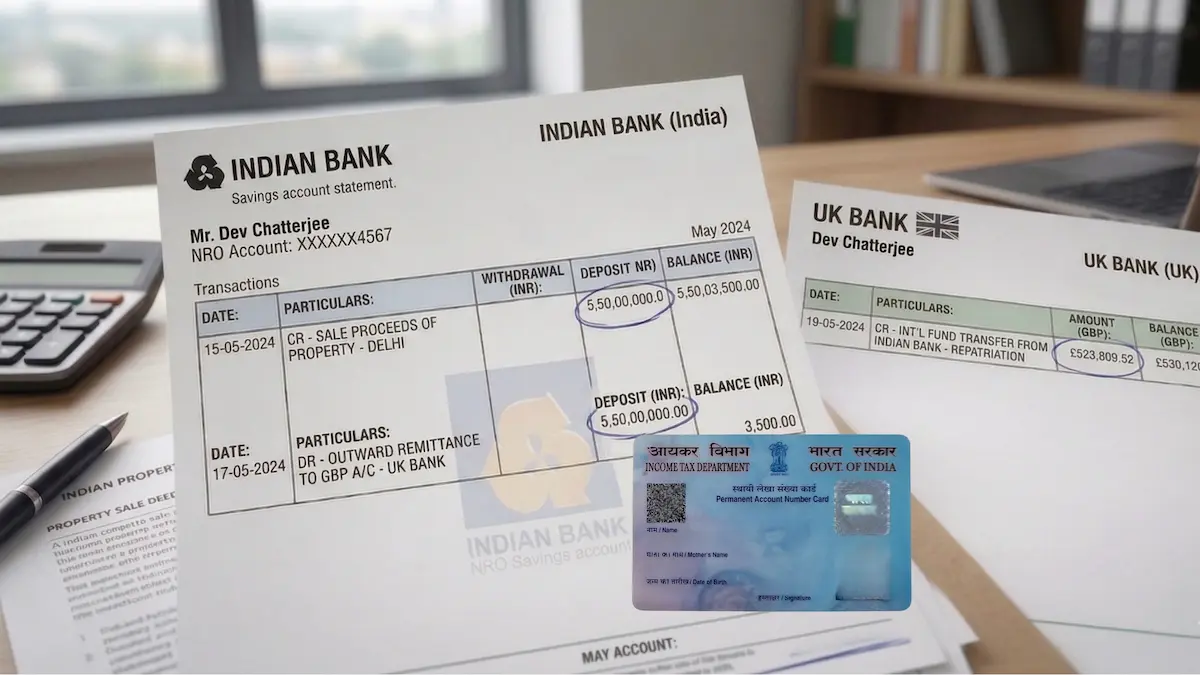
- Verify High-Value Remittances: As shown in the 2026 PAN 2.0 ecosystem, the embedded QR code allows for real-time verification during the outward remittance of property sale proceeds.
- Satisfy TDS Requirements: A PAN ensures that Tax Deducted at Source (TDS) is applied at the correct non-resident rate, preventing the “inoperative” status that often blocks international fund transfers.
- Facilitate International Transfers: To move money from an Indian NRO account to a UK bank, you must furnish your Tax Identification Number (TIN) to align with current global transparency standards.
For a more insightful compliance overview on NRI and OCI property sales, including TDS rates, capital gains, and repatriation rules, see our NRI property sale guide
The repatriation process for foreign citizens involves several steps beyond the PAN application itself — such as Indian property documents, certification for banking and NRO account management. For advice specific to your situation, our Detailed Advice (Indian Law Consultation) may help. Call us on 0208 757 5751 or complete our contact form.
Key Differences from OCI Applicants
OCI holders and non-OCI foreign citizens both use Form 95, but there are practical differences in the application.
Documents. OCI holders must submit a copy of their OCI card in addition to their foreign passport. Non-OCI applicants submit their foreign passport only — no OCI card is required. This simplifies the document set, though attestation requirements may still apply depending on the depository and document type chosen.
Citizenship category on the form. OCI holders select “Overseas Citizen of India.” Non-OCI foreign nationals select “Others” under the foreign citizen category. Selecting the wrong option is one of the most common reasons for rejection and cannot be corrected after submission without a fresh application.
Address proof. Both groups can use a UK bank statement or other documents, depending on the chosen depository. Non-OCI applicants who have resided in India may also use a Foreign Registration Office (FRO) certificate, where applicable.
If you hold OCI status, see our dedicated OCI PAN card guide for the OCI-specific process.
Common Issues for Non-OCI Applicants
Non-OCI foreign citizens encounter challenges that OCI holders do not face to the same degree.
Address proof when no Indian address exists. Most non-OCI applicants do not have an Indian address and must use a foreign address document. A UK bank statement may be a standard option. Some depository portals are stricter about which foreign address documents they accept — check the specific list on your chosen portal (Protean or UTIITSL) before submitting.
Attestation requirements. For non-OCI foreign nationals, documents are more likely to require apostille or attestation by the Indian High Commission than for OCI holders. The specific requirement depends on the document type and the depository used. Submitting unattested photocopies where attestation is required will result in rejection.
AO code selection. For non-OCI foreign citizens applying from the UK with no Indian address, the correct AO code is DLC-C-35-1. See our AO code guide for the full explanation.
Selecting the wrong citizenship category. Non-OCI applicants must not select “Overseas Citizen of India” in the foreign citizen section; doing so would be incorrect. This cannot be corrected after submission.
Frequently Asked Questions
No. OCI status is not required to obtain a PAN card. Any foreign citizen — including those who hold no Indian-origin status — can apply for a PAN using Form 95, provided they have a legitimate financial, property, or tax requirement in India. Your foreign passport serves as the primary identity document.
Yes. British citizens apply for an Indian PAN card using Form 95, the citizenship-based form for all non-Indian passport holders introduced under the Income-tax Rules, 2026. You will need your UK passport, proof of UK address, and your TIN.
Form 95 is the PAN application form prescribed under Rule 158 of the Income-tax Rules, 2026, for any individual who is not a citizen of India. It replaces the legacy Form 49AA. It applies to all foreign nationals — including those with OCI, PIO, or no Indian-origin status — who hold a foreign passport.
Yes. Foreign citizens can apply for a PAN from outside India through the authorised portals (Protean or UTIITSL). Documents may need to be apostilled or attested by the Indian High Commission depending on the document type and your country of residence. Physical cards can be dispatched to a foreign address for an additional fee.
The difference is determined by your passport, not your country of residence. If you hold an Indian passport and live abroad, you are an NRI and apply using Form 93. If you hold a foreign passport — even if you hold OCI status or are of Indian origin — you are classified as a foreign citizen for PAN purposes and must use Form 95. The two forms have different document requirements and obligations.
Once your application is submitted through the depository, PAN allotment typically takes 10-15 working days. Physical card dispatch to a UK address takes a further 2–3 weeks. If your documents require apostille or High Commission attestation, factor in additional time before submission.
How Whytecroft Ford Can Help
Applying for a PAN card as a foreign citizen involves more than completing a form. For most clients, the PAN requirement arises as part of a wider matter — a property transaction, an inheritance, an NRO account, or a repatriation — and understanding the full picture before you begin can prevent delays and avoidable issues.
Whytecroft Ford provides PAN card application assistance for foreign citizens, OCI holders, and NRIs based in the UK. Our service covers document guidance, form completion, guidance on apostille and attestation, and support through to PAN receipt, via the depository.
When your PAN requirement is part of a broader Indian law matter, we also offer an Indian Law Consultation Service that covers property law, procedural compliance overview and cross-border preparatory steps before you travel to India.
To discuss your situation, call us on 0208 757 5751 or complete our contact form. We will confirm the best route forward for your specific circumstances.


