Fact-checked by the Indian Law & Property Team at Whytecroft Ford | Updated for 2026
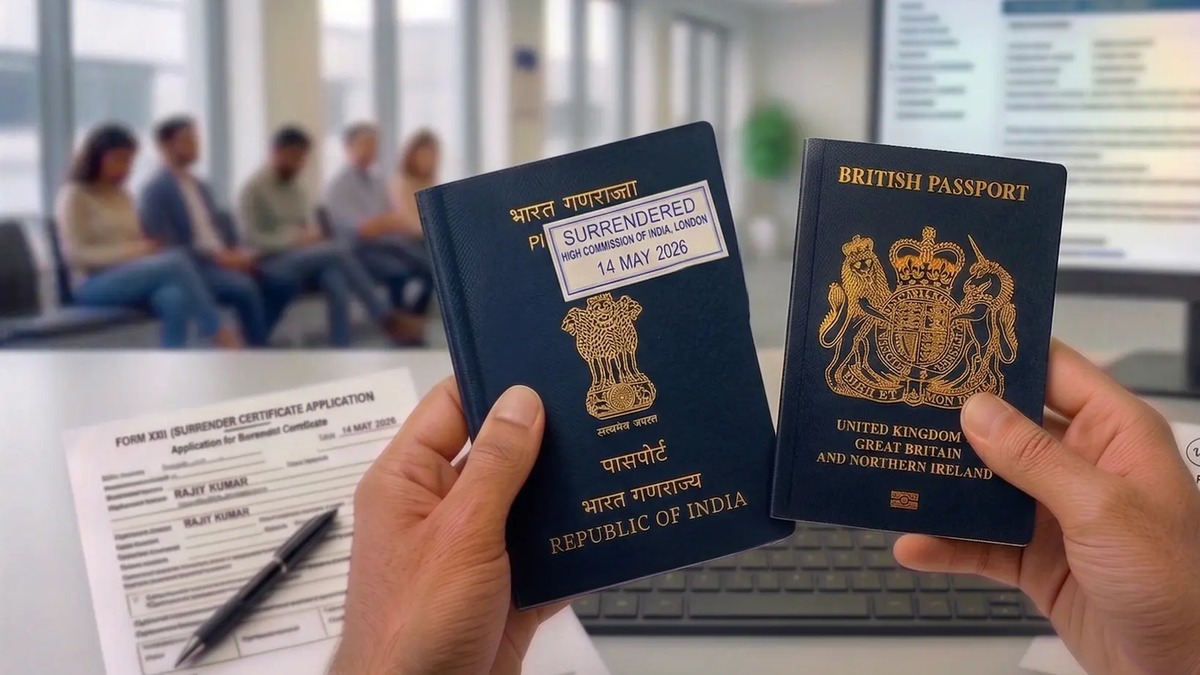
Under the Indian Citizenship Act, 1955, India strictly prohibits dual citizenship. If you are an Indian national who has recently naturalised as a British citizen, you are legally mandated to formally renounce your Indian citizenship and surrender your Indian passport. This overview outlines the VFS Global process, crucial timeline rules, and how your Surrender Certificate impacts your future OCI and PAN applications as a starting point.
If you have already obtained your Surrender Certificate, you may find this helpful: Overseas Citizenship of India (OCI) and NRI & OCI FEMA Compliance.
The Legal Mandate: Why You Must Surrender Your Passport
Acquiring British citizenship automatically terminates your Indian citizenship. However, the administrative cancellation is not automatic; the burden rests on you to formally hand over your passport to the High Commission of India (HCI) via VFS Global.
Once processed, the High Commission will cancel your Indian passport, stamp it as “Cancelled due to acquiring foreign nationality,” and issue you a formal Surrender Certificate.
The 3-Month Grace Period & Travel Penalties
A frequent point of confusion for the UK diaspora is travel immediately following naturalisation. Under Indian law, there is a strict 3-month grace period calculated from the exact date of your naturalisation. During this 3-month window, you may travel on your Indian passport only if your British passport has not yet been issued. Traveling on an Indian passport beyond this 3-month grace period—or traveling on it after you have physically received your British passport—is a violation of the Passport Act, 1967, and attracts heavy financial penalties per journey.
The VFS Global Surrender Process in the UK
To obtain your Surrender Certificate, you must submit an application through VFS Global consular services in the UK.
1. The Crucial Date Requirement
When completing the online surrender application, you must input the date you acquired foreign citizenship. This is the exact date printed on your UK Naturalisation Certificate. Do not use the date your British passport was issued. Entering the incorrect date may result in immediate rejection at the VFS counter.
2. The Name Change Rule
If you legally changed your name during the UK naturalisation process (e.g., via Deed Poll or marriage), you must still apply to surrender the passport using the exact name printed in your last valid Indian passport. The Indian authorities will strictly issue the Surrender Certificate in the name of the surrendered Indian passport, not your new British identity.
3. Mandatory Document Checklist
While the High Commission reserves the right to request additional evidence, a typical surrender application in the UK includes:
- The printed and signed Surrender Application Form.
- The formally signed Declaration/Oath form.
- The original Indian passport (last valid at the time of naturalisation) plus photocopies.
- A copy of your UK Naturalisation Certificate.
- A copy of your current British Passport (if already issued).
- Valid proof of UK address.
- Photographs: Two unmounted, 2-inch x 2-inch (51mm x 51mm) photographs with a white background, strictly adhering to Indian consular specifications.
4. The In-Person Mandate
For the formal renunciation of Indian citizenship, postal applications are generally not permitted. The applicant is legally required to be present in person at the VFS appointment center to sign the official declaration and oath in front of a consular official.
Legal Implications: Why the Surrender Certificate is Vital
Treat your Surrender Certificate like a primary identity document. Losing it causes massive bureaucratic delays, as it serves as the foundational “master key” for two critical transitions.
1. Applying for an OCI Card
If you are applying for Overseas Citizenship of India (OCI) on the basis of your own previous Indian nationality (Self/PIO), the Surrender Certificate is a mandatory foundational document. It serves as absolute legal proof to the Ministry of Home Affairs that you have lawfully cleared your citizenship transition. Without it, your OCI application cannot proceed.
2. Updating your PAN Card & KYC
Your financial identity must transition alongside your physical citizenship. Upon becoming a British citizen, your tax residency and legal status change. You must notify the Indian Income Tax Department to update your Permanent Account Number (PAN) from a “Resident Indian” to a “Foreign Citizen” profile. Failing to update your PAN and submit your Surrender Certificate for banking KYC can render your PAN inoperative and temporarily freeze your NRO/NRE bank accounts.
Frequently Asked Questions
To discuss surrendering your Indian passport with our team, contact us on 020 8757 5751 or use our contact form to get in touch.
Yes. Following the surrender process, the High Commission of India will return your original Indian passport to you. It will physically bear a “Cancelled” stamp, but you should retain it permanently as historical proof of your Indian heritage for future legal matters.
If your Indian passport was lost or destroyed, you cannot apply for a standard Surrender Certificate. Instead, you must apply for a “Renunciation Declaration” through VFS Global, which involves submitting a formal police report regarding the lost document, alongside a notarised affidavit explaining the circumstances.
Yes. Every individual who held an Indian passport and acquired foreign citizenship, including minors, must undergo the formal surrender process and obtain their own Surrender Certificate to apply for an OCI card.


