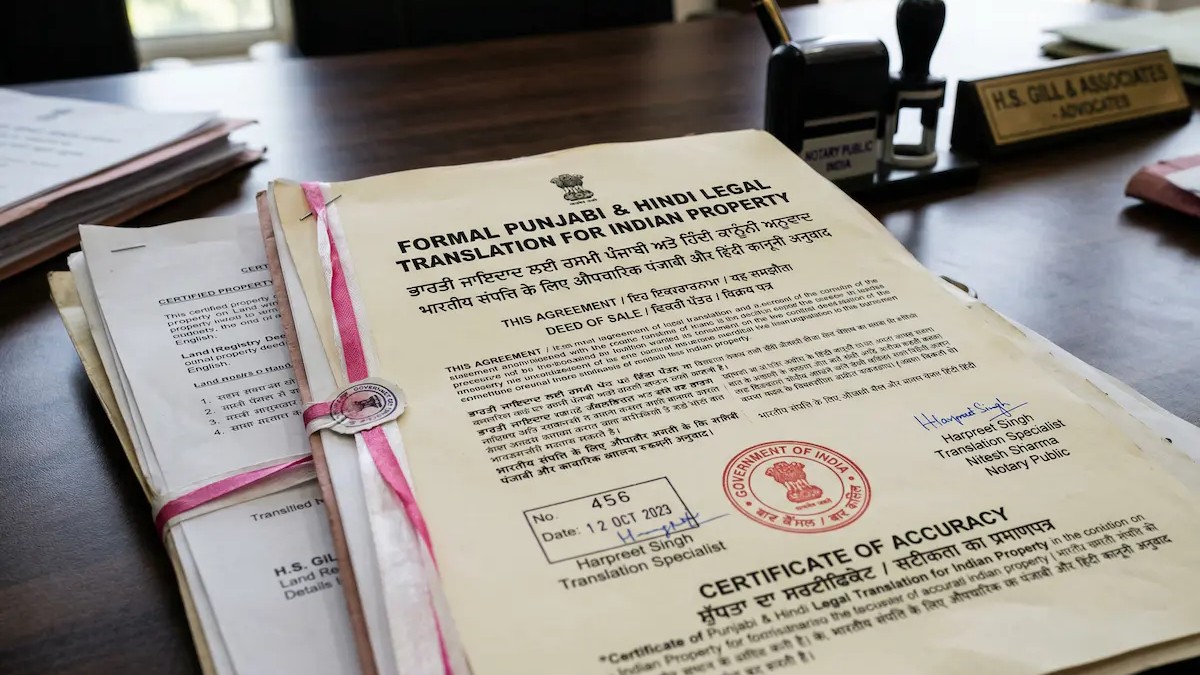
Fact-checked by the Indian Law & Property Team at Whytecroft Ford | Updated for 2026
For Non-Resident Indians (NRIs) based in the UK, dealing with ancestral property often means navigating complex legal documents written entirely in regional Indian languages such as Punjabi (Gurmukhi) or Hindi. Whether you are attempting to understand your ownership share in a family farm or submitting evidence to a UK court, securing a certified legal translation is a foundational step in protecting your overseas assets.
If you are dealing with a broader property issue, understanding your documents perfectly complements our core Indian Property Inheritance and Indian Property Dispute legal guides.
The Language Barrier in Indian Property Law
Generational Indian property documents—such as land titles, historical wills, and partition agreements—are rarely drafted in English. They are officially recorded in the native language of the state. For the UK diaspora, this creates a significant vulnerability.
If you cannot accurately read the documents associated with your inheritance, you cannot effectively manage, sell, or protect your shares. Relying on verbal summaries from relatives in India often leads to misunderstandings regarding exact acreage, co-ownership clauses, or pending financial encumbrances.
Common Indian Property Documents Requiring Translation
- Fard / Jamabandi: The official land revenue records that detail the exact ownership of agricultural land, exact shares, and cultivation rights.
- Rajistri (Registry / Sale Deed): The official registered proof of property transfer and ownership.
- Intqal (Mutation Records): The administrative record showing the transfer of title in the local municipal or panchayat revenue registers.
- Wasiyat (Wills): Historical handwritten or registered wills detailing generational asset distribution.
- Power of Attorney (Mukhtarnama): Legal mandates granting financial and property rights to a third party.
The Risks of Informal Translation
It is a common scenario for UK NRIs to ask a bilingual family member or friend to provide a “rough translation” of a Punjabi or Hindi property document. While an informal, domestic translation might give you the general gist of the document, it is highly inadequate in a formal legal context.
1. The Failure of Literal Translation
Legal Indian documents utilise archaic revenue terminology (often heavily influenced by historical Persian and Urdu land terms) that do not have direct, everyday English equivalents. A standard bilingual speaker, or a digital translation tool, will fail to accurately interpret the binding legal context of terms like Khewat (account number) or Khasra (survey number).
2. Inadmissibility in UK Courts and HMRC
If you are dealing with a cross-border divorce in a UK Family Court, or declaring overseas inherited assets to HM Revenue & Customs (HMRC) for probate and inheritance tax purposes, you must provide absolute proof of what the document says. UK authorities, banks, and courts will not accept an uncertified domestic translation. They strictly require a certified professional translation accompanied by a formal statement of truth from the translator.
The Strategic Value of Professional Legal Translation
A certified legal translation ensures that the translated document accurately conveys the exact legal intent, style, and context of the original Indian document.
- Identifying Accurate Ownership Shares: In joint family properties, the Fard dictates ownership in highly specific fractional shares. A professional translator ensures these fractions and land measurements (such as Kanals and Marlas) are mathematically and legally accurately translated into English so shareholders have a unified, transparent understanding of their assets.
- Preventing Fraud: Before signing any new agreement, Power of Attorney, or relinquishment deed in India, having it professionally translated into English ensures you are not inadvertently signing away rights or accepting liabilities you did not understand.
- Resolving Disputes: In the event of an illegal occupation or family dispute, a certified translation allows your UK-based legal advisors to accurately assess the strength of your title and build a robust, evidence-based legal strategy.
Translation Costs and Timelines
The cost of translating Indian property documents from Punjabi, Hindi, or Gujarati into English varies based on the complexity, legibility, and length of the historical document.
- Pricing Structure: Professional legal translation is typically assessed on a per-word basis (often ranging from £0.10 to £0.50 per word, depending on the density of legal terminology and the language pair); fee structures may vary.
- Historical Documents: Older documents, such as handwritten wills or fading 1960s land registries, often require forensic linguistic interpretation before they can be accurately translated, which may require additional time and affect the final assessment fee.
When navigating cross-border property matters, a multi-disciplinary approach is often adopted to support the several processes involved in Indian property matters.
Explore Related Services
- Indian Power of Attorney Services: Legal mechanisms for executing cross-border property transactions and regulatory documentation from the United Kingdom.
- Sell Property in India: An overview of the procedural mandates for property disposal, from initial title clearance to the execution of the final Sale Deed.
- Indian Law Consultation: speak with us for Indian law advisory services and be better equipped to sell your property.
- PAN Card Assistance: Meet all your obligations as an OCI for Selling Indian Property.
To discuss your legal document translation with our team, contact us on 020 8757 5751 or use our contact form to get in touch.


