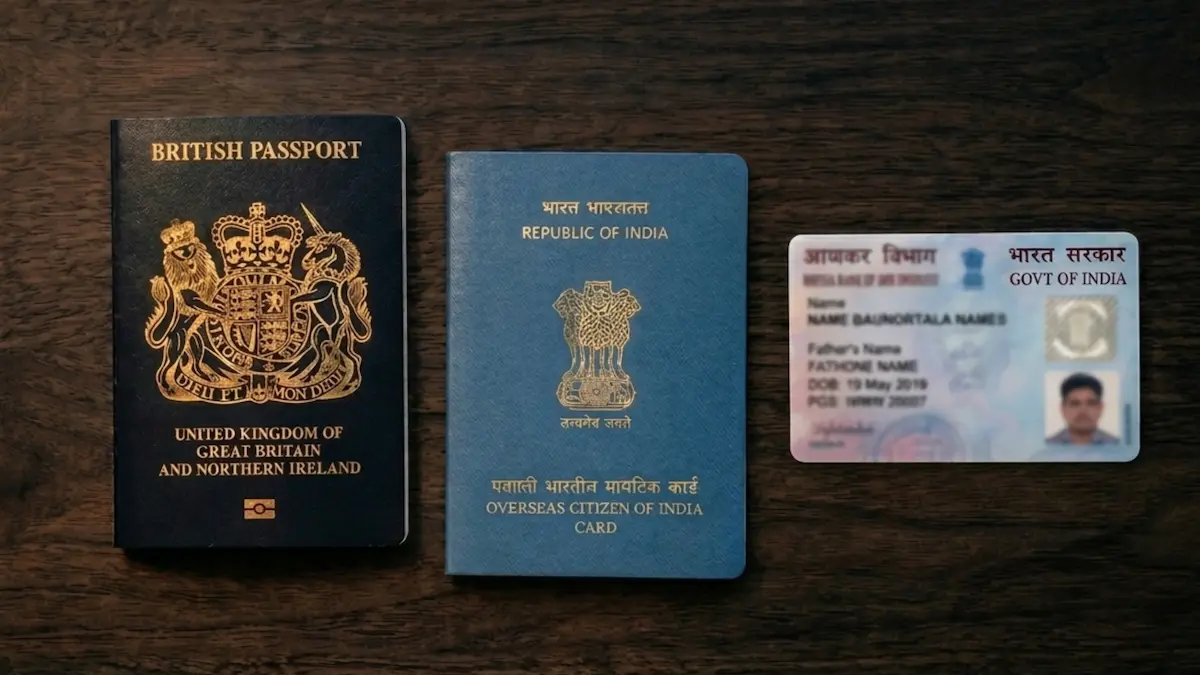
Last reviewed: April 2026
✔ Fact-checked by the Indian Law & Property Team at Whytecroft Ford
How do I apply for an OCI PAN Card 2.0? Since April 1, 2026, Overseas Citizens of India (OCI) must use the new Form 95 to apply for or upgrade to a PAN 2.0 card. Although upgrading from the PAN 1.0 version is not yet mandatory, it is optional. This digital-first process requires selecting “Overseas Citizen of India” as your citizenship type, providing a mandatory Taxpayer Identification Number (TIN) from your country of residence, and submitting a valid foreign passport. The upgraded card features an enhanced QR code for instant Indian banking KYC and property transaction compliance.
A Vital Step Before Beginning: Your Resident/Citizenship Status
As an OCI, your PAN card 2.0 application process differs from that for NRI PAN card applications. Both are distinct forms of status as defined by the Government of India, despite the overlap in common use of the term “NRI.” Therefore, the first step is to ensure the accuracy of your citizenship and resident status.
If you are a foreign spouse applying for OCI status for the first time, see our guide to OCI card eligibility and the two-year marriage rule.
The New 2026 Standard: From Form 49AA to Form 95
While you may see reference to “NRI PAN Cards” across the web, the PAN 2.0 initiative has introduced a strict legal distinction. As of April 2026, the legacy Form 49AA is replaced by Form 95 for anyone who is not a citizen of India. Simply, this means you do not hold an Indian passport.
If you hold a foreign passport and are an OCI cardholder, Form 95 is your only path to obtaining the new QR-coded PAN card required for modern Indian financial transactions.
5 Mandatory Requirements for OCI Applicants
To avoid rejection under the new automated validation system, your application must meet these specific 2026 criteria:
- Correct Citizenship Designation: You must explicitly select the “Overseas Citizen of India” checkbox.
- Mandatory TIN Disclosure: You are now required to provide the Taxpayer Identification Number (TIN) issued by the country where you currently reside. For example, if you are a British citizen, then you must provide your National Insurance Number.
- Full Legal Name (No Abbreviations): Your name must be written in full in BLOCK LETTERS with no abbreviations.
- Digital Contact Info: A valid Mobile Number (including international country code) and Email ID are mandatory for receiving your digital PAN 2.0 alerts .
- Specific Photo Formatting: Two colour photos (4.5 cm x 3.5 cm) are required.
For the full step-by-step application process — including AO code selection, portal submission, document attestation, and tracking — see our complete guide to applying for a PAN card from the UK.
Why the OCI PAN 2.0 Card is Essential
The hallmark of the 2.0 upgrade is the embedded QR code. For the global Indian diaspora, this technology streamlines the friction of “paper-based” verification. Whether you are opening an NRE account or selling Indian property, the QR code potentially allows Indian institutions to verify your tax status in real-time. A PAN card is required for most high-value financial transactions in India.
Why OCI Holders Need a PAN Card
For most OCI holders, a PAN card becomes necessary when dealing with India financially. Common situations that trigger the requirement include:
Property transactions. Buying, selling, or transferring immovable property in India requires a PAN regardless of OCI status. Where the seller is a non-resident, the buyer must deduct TDS from the purchase price, and both parties require a PAN for the transaction to proceed through compliant channels.
NRO account banking. Indian banks require a PAN to open a Non-Resident Ordinary (NRO) account or to meet KYC obligations on an existing account. An NRO account is the standard channel for receiving Indian-source income — rental income, dividends, or property sale proceeds — before repatriation.
Receiving inherited assets. Where property or funds pass to an OCI holder by inheritance, a PAN is required to receive proceeds and to satisfy TDS obligations on the estate.
Tax compliance. If you earn rental income, pension, or dividend income from India, you are required to file an Indian income tax return. A PAN is mandatory for this, and without one, TDS may be deducted at the maximum applicable rate rather than the relevant treaty rate.
Investment in Indian financial instruments. Opening a Demat account, buying Indian property, investing in Indian mutual funds, or purchasing fixed deposits all require a valid PAN. For a full overview of when PAN is mandatory under FEMA, see our NRI PAN compliance guide.
Documents Needed as an OCI Holder
To apply error-free, your supporting documents ideally should be gathered prior to applying. The full list of acceptable documents can be found on the respective authorities’ official websites, depending on the depository selected for the application. Here are some examples of types of documents:
Proof of identity: your current foreign passport.
OCI card: a copy of your current OCI card. If your documentation is in the legacy PIO booklet format that was converted to OCI status, you may be asked for additional documentation. Check with the depository portal before submitting.
Proof of overseas address: a recent UK bank statement or OCI card copy.
Taxpayer Identification Number (TIN): for example, your UK National Insurance number. This is mandatory under the 2026 rules.
Photographs: two recent colour photographs, 4.5 cm x 3.5 cm. These are Indian PAN specifications — UK passport photo dimensions are different and will not be accepted.
Attestation: depending on the depository you use (Protean or UTIITSL), supporting documents may need to be apostilled or attested by the Indian High Commission. Check the specific requirements on your chosen portal before printing and signing. If you are unsure, our PAN card application service includes a document review before submission.
Common OCI PAN Card Issues
OCI applicants face a higher rejection rate than NRI applicants largely because the document and name-matching requirements are stricter. The most common issues are:
Name mismatch between OCI card and passport. If your name appears differently on your OCI card and your current foreign passport — due to marriage, deed poll, or a clerical difference — the application will be rejected. The discrepancy must be resolved before applying, either by updating your OCI card or providing an attested linking document such as a marriage certificate or deed poll.
Expired or legacy OCI documentation. Some OCI holders hold documentation in the old PIO card format that was converted to OCI status. If your documentation is not in the current OCI card format, you may face additional scrutiny. Check what format is acceptable with the depository before submitting.
Incorrect photograph specifications. UK passport photo dimensions are not the same as the Indian PAN specification. Photographs that do not meet the 4.5 cm x 3.5 cm requirement will cause rejection.
Signature placement errors. Signatures must fall exactly within the boxes on the printed form. Touching the border, signing across a photograph, or signing outside the box invalidates the form and requires resubmission from the start.
Missing or incorrect TIN. Leaving the TIN field blank or entering an incorrect reference number is one of the most common reasons for rejection under the 2026 automated validation system. UK applicants should enter their National Insurance number exactly as it appears on their NI card or HMRC correspondence.
How Whytecroft Ford Can Help
Applying for a PAN card as an OCI holder from the UK involves more than completing the online form. The document attestation requirements, photograph specifications, and the name-matching rules between your OCI card and passport require careful consideration for first-time applicants.
Whytecroft Ford provides PAN card application assistance for OCI holders and non-OCI foreign citizens in the UK. The service covers document review, assistance with form preparation, attestation guidance where required, and submission support, ensuring your application is correct before it leaves the UK.
Where your PAN requirement is part of a wider matter — an Indian property transaction, an inheritance, NRO banking, or Indian property compliance — our Indian Law Consultation Service is tailored to advise on your specific situation.
To begin, see our PAN card application service. To discuss your situation, call us on 0208 757 5751 or complete our contact form.
Frequently Asked Questions
No. While Aadhaar is mandatory for Indian residents, it remains an optional field for individuals who are not citizens of India.
No, you do not need a new number. Your existing PAN remains valid.
Yes, you can select “Office Address” for communication. However, if you choose this option, you must provide specific Proof of Office Address as an annexure to your application. Most OCI applicants prefer using their residence address to simplify the documentation process.
There is no separate OCI PAN card or NRI PAN card — there is only a PAN card. The difference is in the application form. OCI holders use Form 95 because they hold a foreign passport. NRIs who hold an Indian passport use Form 93. The PAN card issued is the same in both cases.
No. Your current foreign passport is the required proof of identity for Form 95. Your OCI card is submitted as an additional document to confirm your OCI status but cannot replace the passport as the primary identity document.


