TB Test Requirement for UK Visa Applications
If you are applying for a UK visa of more than 6 months from one of around 100 listed countries, you must take a tuberculosis (TB) test before submitting your application. This 2026 guide covers who needs the test, where to take it, the cost, and what happens if you test positive.
The seven things you actually need to know
Who needs to take a TB test for a UK visa?
You need a TB test if all three of these apply: (1) you are applying for a UK visa of more than 6 months, (2) you are resident in a listed country, and (3) you have been in that country for 6 months or more immediately before applying.
- Visa duration is more than 6 months
- You are resident in a listed country
- You have been in that country for 6+ months
- You are applying for any settlement-bound route from a listed country
- This applies to family, work, study, and most other long-term routes
- Your visa is for 6 months or less (visitor, short-term)
- You are applying from a country not on the list
- You have been outside listed countries for 6+ months
- You are applying in-country (extension or switch within the UK)
- You qualify for a specific exemption (diplomats, certain returning residents)
Routes where the TB test typically applies
- Spouse, partner, fiance and family visas (33-month grants)
- Skilled Worker visa (3+ year grants)
- Health and Care Worker visa
- Student visa (most courses are over 6 months)
- Innovator Founder, Scale-up
- Most settlement-bound routes
Routes where it does not apply
- Standard Visitor visa (any duration up to 6 months)
- Marriage Visitor visa (6 months)
- Transit visas
- Permitted Paid Engagement Visitor (1 month)
- Short-term Student English language (up to 6 months)
- Most in-country extension applications (FLR-M, etc.), already in the UK
The "6 months or more in a listed country" rule sometimes catches applicants out. If you have lived in the UK for several years on a previous visa and travel to your home country shortly before applying, you may not need a TB test, provided you have been outside listed countries for 6+ months. The Home Office assesses your residence at the time of application.
Which countries require a TB test for UK visas?
The Home Office lists the countries where, if you have lived there for 6 months or more, you must take a TB test before applying for a UK visa of more than 6 months. As of the GOV.UK update of 29 April 2026 there are 102 listed countries. The requirement is based on where you have lived, not your nationality.
Countries marked † have no approved clinic in-country, so the test must be taken in another country.
- Afghanistan
- Algeria
- Angola
- Armenia
- Azerbaijan
- Bangladesh
- Belarus
- Benin †
- Bhutan
- Bolivia
- Botswana
- Brunei
- Burkina Faso †
- Burundi
- Cambodia
- Cameroon
- Cape Verde †
- Central African Republic †
- Chad
- China
- Congo †
- Côte d’Ivoire
- Democratic Republic of the Congo
- Djibouti †
- Dominican Republic
- East Timor (Timor-Leste) †
- Ecuador
- Equatorial Guinea †
- Eritrea †
- Ethiopia
- Gabon †
- Gambia
- Georgia
- Ghana
- Guatemala
- Guinea †
- Guinea-Bissau †
- Guyana
- Haiti
- Hong Kong
- India
- Indonesia
- Iraq
- Kazakhstan
- Kenya
- Kiribati †
- Kyrgyzstan †
- Laos
- Lesotho †
- Liberia †
- Macau †
- Madagascar
- Malawi
- Malaysia
- Mali †
- Marshall Islands †
- Mauritania †
- Micronesia †
- Moldova
- Mongolia
- Morocco
- Mozambique
- Myanmar (Burma)
- Namibia
- Nepal
- Niger †
- Nigeria
- North Korea
- Pakistan
- Palau †
- Panama
- Papua New Guinea
- Paraguay
- Peru
- Philippines
- Russia
- Rwanda
- São Tomé and Príncipe †
- Senegal
- Sierra Leone
- Solomon Islands
- Somalia †
- South Africa
- South Korea
- South Sudan †
- Sri Lanka
- Sudan
- Suriname †
- Eswatini (Swaziland) †
- Tajikistan
- Tanzania
- Thailand
- Togo †
- Turkmenistan
- Tuvalu †
- Uganda
- Ukraine
- Uzbekistan
- Vanuatu
- Vietnam
- Zambia
- Zimbabwe
† No approved clinic in-country; the test must be taken in another country.
The Home Office maintains the official, current list at gov.uk/tb-test-visa. The list changes occasionally as WHO tuberculosis prevalence data is updated, so always check the live list before booking your test or applying.
What does the TB test process involve?
The standard TB test for UK visa applicants is a chest X-ray for adults aged 11 and over. Children under 11 receive a clinical examination instead. The whole process takes 15-30 minutes at the clinic.
What happens at the test
Arrive at the clinic
Bring your passport, the booking confirmation, and the test fee. The clinic verifies your identity against the booking.
Medical history questions
The clinician asks about TB symptoms (cough, fever, weight loss, night sweats), previous TB exposure, BCG vaccination history, and any current medications.
Chest X-ray (adults 11 and over)
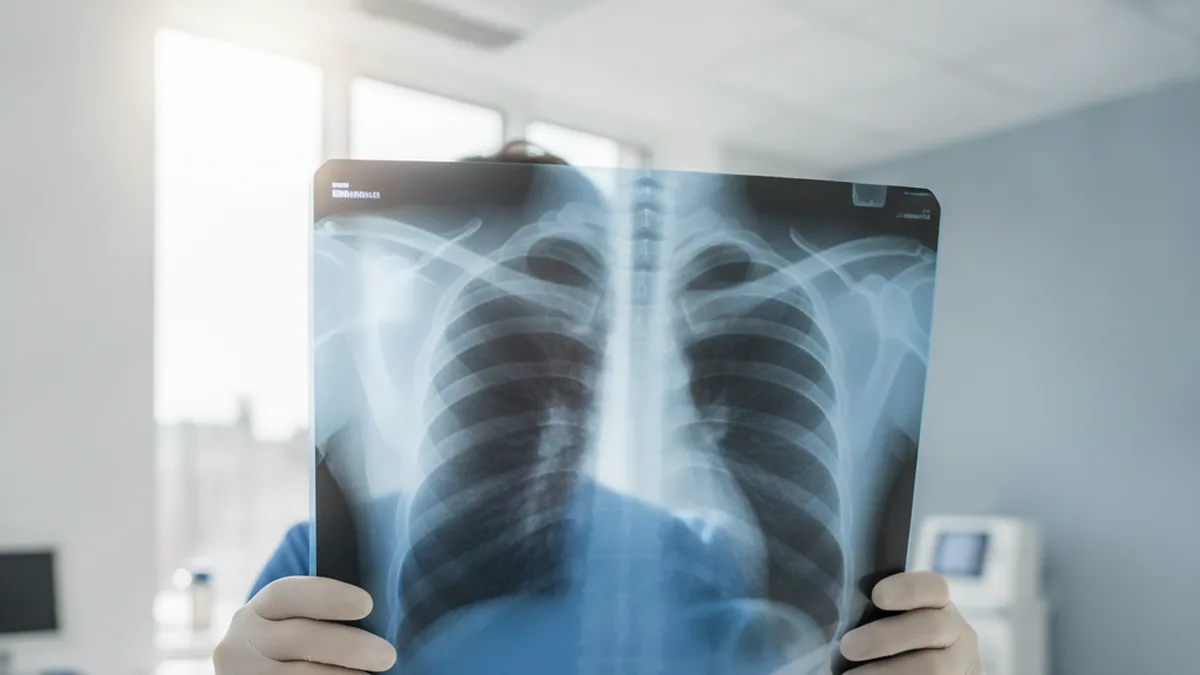
A standard chest X-ray to check for signs of active TB. Takes 5-10 minutes. You change into a gown and the X-ray technician positions you for the image.
Clinical examination (children under 11)
Children under 11 are not X-rayed unless symptoms are present. Instead, a clinical examination, history, and possibly sputum test if indicated.
Initial result on the day
If the X-ray is clear, you receive your TB certificate before leaving the clinic. Some clinics issue a paper certificate immediately; others email a digital version within 24-48 hours.
Follow-up tests (if indicated)
If the X-ray shows abnormalities or you have symptoms, you may be asked to provide sputum samples for further testing. This can take 8-12 weeks for results.
What to bring
- Passport (the same passport for your visa application)
- Booking confirmation
- Test fee (cash, card, or as specified by the clinic)
- Recent passport photos (some clinics require these)
- BCG vaccination record if you have one (not required, but useful)
- Any previous TB-related medical records
Special groups
- Pregnant women: X-ray with abdominal shielding. Some clinics may delay X-ray until after pregnancy and offer alternative screening.
- Children under 11: Clinical examination, no X-ray unless symptoms.
- HIV-positive applicants: Additional screening protocols and longer testing process.
- Applicants with previous TB: Full medical history review and potentially additional sputum testing.
Where are the approved TB test clinics?
The TB test must be taken at a clinic on the official UKVI-approved list. Most are operated by the International Organization for Migration (IOM) or partner medical providers. The Home Office does not accept tests from non-approved clinics, even if the clinical quality is equivalent.
How to find an approved clinic
- Visit gov.uk/tb-test-visa/approved-clinics
- Select your country of residence
- The page lists approved clinics with addresses, phone numbers and websites
- Book an appointment directly with the clinic, usually online or by phone
- Confirm the appointment and verify the clinic name matches the official list
Common approved providers
- IOM (International Organization for Migration), operates UK TB testing in many countries including India, Pakistan, Bangladesh, Nigeria, Kenya, Philippines
- Visa Medical Services, partner provider in some regions
- Knightsbridge Hospital, approved provider in Pakistan
- Smithies Medical, approved provider in some regions
The exact provider varies by country. Some countries have only one approved clinic; others have multiple options.
Beware of unofficial clinics or "TB testing services" that charge but are not on the UKVI-approved list. Their certificates will not be accepted by the Home Office. Always verify the clinic name and address on the official GOV.UK page before paying.
How much does a TB test cost?
TB test costs vary significantly by country, typically £100 to £300 per adult. Children pay reduced fees. Cost is determined by the approved clinic and the country's medical pricing.
Typical costs by region
| Country / region | Typical adult cost | Child cost |
|---|---|---|
| India | £90-£150 | £50-£90 |
| Pakistan | £100-£150 | £50-£90 |
| Bangladesh | £100-£140 | £50-£80 |
| Nigeria | £150-£250 | £80-£150 |
| Philippines | £120-£180 | £70-£120 |
| South Africa | £200-£300 | £100-£200 |
| Russia / Eastern Europe | £150-£250 | £80-£150 |
| China | £150-£200 | £80-£150 |
| Other listed countries | £100-£300 | £60-£200 |
What's included in the fee
- Medical history consultation
- Chest X-ray (or examination for under-11s)
- Initial certificate if test is clear
- Email or postal copy of the certificate
Additional costs
- Sputum tests if indicated: £50-£150 additional
- Repeat tests if certificate lost or expired: full fee again
- Express service (where offered): £30-£70 premium
- TB treatment if positive: variable, can be substantial
For a family of four applying for a spouse visa from a high-cost country, TB testing can add £400-£800 to the application cost. This is on top of the £4,800+ in Home Office fees and IHS. Build the TB test cost into your spouse visa budget when applying from a listed country.
How long is the TB certificate valid?
A TB certificate is issued after a clear test result. It is valid for 6 months from the date of the test. You must submit your visa application within this window or repeat the test.
What's on the certificate
- Your full name (matching your passport)
- Date of birth
- Passport number
- Date of test
- Result (Clear / Negative for active TB)
- Clinic name and reference number
- Signature of authorised medical practitioner
Format
Most clinics issue both a paper certificate and a digital PDF version. The digital PDF is what you upload with your visa application. Keep the paper version safe in case it is requested for further verification.
Six-month validity
Your TB certificate is valid for 6 months from the test date. Your visa application must be submitted within this 6-month window. If your application is delayed beyond 6 months, the certificate expires and you need to retake the test.
Plan your timing
Take the TB test 1-3 months before your intended visa application date. This window allows for:
- Initial test and certificate issuance (typically same day or 24-48 hours)
- Time to gather other application documents
- Buffer if any follow-up tests are needed
- Possible delays in your visa application timeline
Avoid taking the test more than 4 months before applying, it leaves less buffer if your application is delayed.
What happens if you test positive for TB?
A positive TB test does not automatically mean your visa is refused. You undergo treatment, complete it, and then receive a clear certificate. Once cleared, you can proceed with your application. The process can take several months.
The treatment pathway
Initial diagnosis
If the chest X-ray shows abnormalities, the clinic refers you for sputum testing to confirm whether you have active TB.
Sputum tests
You provide sputum samples (usually 3 separate days). Laboratory analysis confirms or rules out active TB.
If active TB confirmed
You begin treatment under local medical care. Standard TB treatment lasts 6 months minimum, sometimes longer for resistant strains.
Treatment completion
After completing treatment, you return to the approved clinic for re-testing. A fresh chest X-ray and sputum samples confirm you are clear.
Clear certificate issued
Once cleared, the clinic issues a fresh TB certificate. The 6-month validity starts from this new test date.
Visa application proceeds
With the clear certificate, your UK visa application can proceed normally. The earlier positive test does not prejudice the application, only your current status is assessed.
Latent TB
Some applicants have latent TB, the bacteria are present but not active. Latent TB does not normally prevent visa approval. The TB testing for UK visas screens for active TB only. If you have a history of latent TB without current active disease, you can typically receive a clear certificate.
Treatment costs
TB treatment costs vary by country. In some countries, government health systems provide free TB treatment. In others, private treatment costs hundreds or thousands of pounds. Check local healthcare provisions where you live.
How does TB testing work for children and pregnancy?
Children under 11 and pregnant women have modified TB testing protocols. Most children get a clinical examination instead of X-ray. Pregnant women receive shielded X-rays or testing alternatives.
Children under 11
- Standard test is a clinical examination, not chest X-ray
- Includes medical history, physical examination, and BCG vaccination check
- Sputum test or X-ray only if symptoms suggest TB
- Reduced fee compared to adult test
- Certificate issued same day in most cases
Children 11-17
- Standard adult X-ray protocol applies
- Parental consent required
- Parent or guardian usually accompanies the child
Pregnant women
X-ray during pregnancy is not normally performed. Options for pregnant applicants:
- Shielded X-ray (lead apron over abdomen), performed at clinical discretion
- Delay test until after delivery (and visa application timing accordingly)
- Alternative screening through medical history and physical examination if no TB symptoms
Discuss your specific situation with the approved clinic before booking. They will advise on the safest approach.
HIV-positive applicants
HIV-positive applicants undergo additional TB screening because HIV increases TB risk. Expect:
- More detailed medical history
- Chest X-ray plus sputum testing routinely
- Longer testing process (8-12 weeks if sputum results awaited)
- Possible additional treatment requirements
Applicants with disability
Approved clinics accommodate applicants with mobility limitations, hearing or sight impairment, and other needs. Notify the clinic when booking so they can prepare appropriate accommodations.
What are the common TB testing issues?
Most TB tests proceed without complication. The recurring issues are usually administrative, booking errors, name mismatches, certificate delivery problems.
Recurring problems
- Name mismatch between booking and passport. Ensure exact match before attending the test.
- Booked at unofficial clinic. Always verify against the GOV.UK approved list before paying.
- Certificate not received. Most clinics email within 24-48 hours; chase via the clinic's contact details if delayed.
- Test taken more than 6 months before submission. Certificate expired; retest required.
- Positive result and treatment delay. Plan your visa timeline around treatment completion.
- Lost certificate. Contact the clinic for a duplicate; usually issued within days.
- Test result inconclusive. Sputum test required; adds 8-12 weeks to your timeline.
If your visa application is delayed
If your visa application timeline slips and your TB certificate expires before submission, you must retake the test. There is no extension or grace period. Plan to submit within the 6-month validity window, with buffer.
Glossary of terms
Frequently asked questions
Talk to a regulated immigration adviser
The Whytecroft Ford Immigration Team advises applicants and sponsors at every stage of a UK visa, settlement or nationality matter. Every file runs on a written engagement letter, with a named handler and a named supervisor.