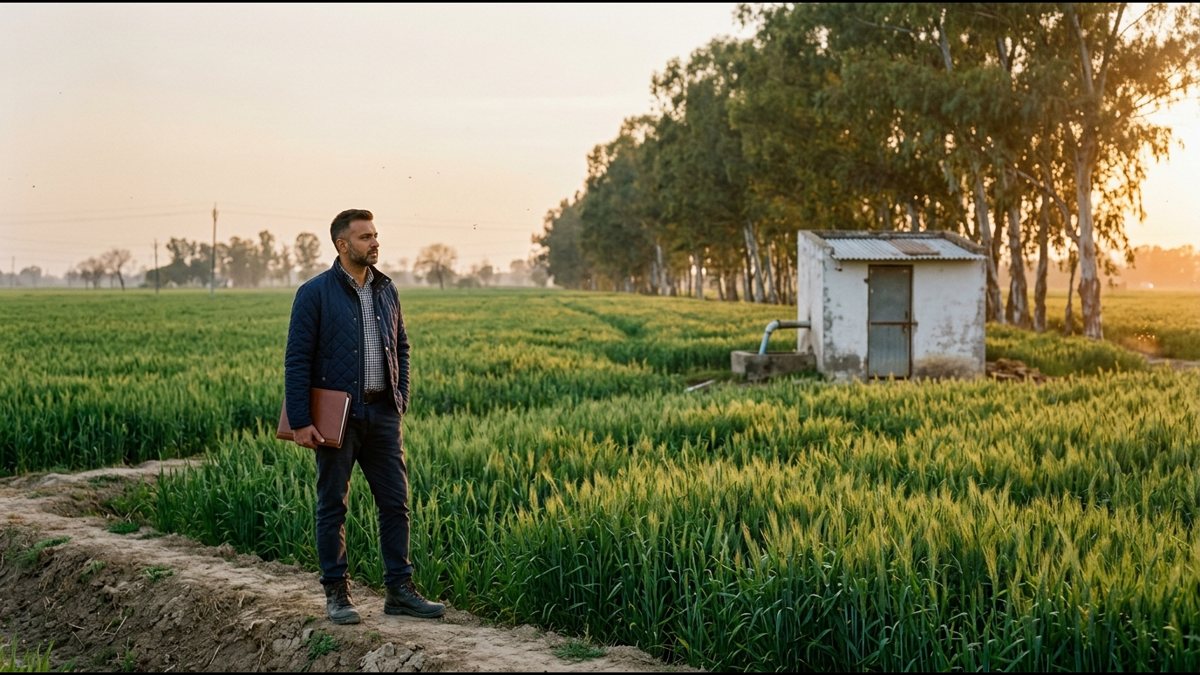
A Non-Resident Indian (NRI) or Overseas Citizen of India (OCI) can sell Indian agricultural land only to a person resident in India. The Foreign Exchange Management Act 1999 treats agricultural land differently from other property, and it usually reaches an NRI or OCI only by inheritance. This post provides an overview of the rules for selling agricultural land in India as an NRI or OCI.
What do the FEMA rules say about NRIs selling agricultural land?
An NRI or OCI can sell agricultural land, but only to a person resident in India. An NRI or OCI cannot sell agricultural land, a farmhouse or plantation property to another NRI, an OCI or a foreign national living abroad.
The restriction comes from Rule 24 of the Foreign Exchange Management (Non-debt Instruments) Rules 2019. The Central Government made these rules under the Foreign Exchange Management Act 1999. Rule 24(d) allows an NRI or OCI to “transfer any immovable property in India to a person resident in India”. Rule 24(e) allows a transfer to an NRI or OCI only of property “other than agricultural land or farm house or plantation property”. The RBI Master Direction on the acquisition and transfer of immovable property restates the same rules.
Who can buy agricultural land from an NRI or OCI?
Only a person resident in India can buy agricultural land from an NRI or OCI. Under the Foreign Exchange Management Act 1999, residence depends on the buyer’s stay in India and the purpose of that stay, not on nationality alone. In practice, the buyer is usually a relative, neighbour or local farmer living in India. A family member living abroad cannot buy the land, however close the relationship.
State land laws can narrow the field further. Some states allow agricultural land to be bought only by an agriculturist, or require the Collector’s permission for a sale to anyone else. In Maharashtra and Gujarat, for example, a sale to a non-agriculturist generally needs the Collector’s permission under the state tenancy and agricultural lands legislation.
Can NRIs ever become eligible to buy agricultural land?
Only by ceasing to be an NRI. The bar in Rule 24 applies to a person resident outside India. An Indian citizen who becomes a person resident in India is no longer restricted by it.
Residence for this purpose is defined in section 2(v) of the Foreign Exchange Management Act 1999. It looks at whether the person stayed in India for more than 182 days in the preceding financial year. It also looks at the purpose of the stay, such as employment or settling in India for an uncertain period. A short visit or a holiday, however long, does not change a person’s status.
Once resident, the person can buy agricultural land, subject to state land law and any rule that only an agriculturist may buy. Becoming resident in India also changes the person’s banking and tax position, so it is not a step to take only to buy land.
How can an NRI or OCI own agricultural land in the first place?
An NRI or OCI cannot buy agricultural land, or receive it as a gift. Agricultural land can only come into their ownership in one of two ways.
- By inheritance. Rule 24(c) permits an NRI or OCI to acquire any immovable property by inheritance from a person resident in India, or from a person resident outside India who acquired it lawfully.
- By holding land acquired while resident in India. Under section 6(5) of the Foreign Exchange Management Act 1999, a person resident outside India can hold, own and transfer property acquired when they were resident in India.
Land held in either way can be kept indefinitely. The restriction applies only when the owner sells or gives it away.
Can I gift agricultural land to an NRI relative?
No. Agricultural land cannot be gifted to an NRI or OCI relative living outside India, even a parent, child or sibling.
Rule 24(b) allows an NRI or OCI to receive a gift of property from a relative. It excludes “agricultural land or farm house or plantation property”. The bar applies whether the person making the gift lives in India or abroad. Section 2(ze) of the Foreign Exchange Management Act 1999 defines “transfer” to include a gift. The same restriction therefore applies to a gift as to a sale.
An NRI or OCI can, however, gift agricultural land to a relative who is a person resident in India. Where only some co-heirs live in India, the non-resident heirs can transfer their shares to the resident heirs by gift or release. The resident heirs can then sell the land as a whole.
What must be in place before inherited agricultural land is sold?
The heirs’ names must first appear in the land revenue records. Until the record of rights is updated, the buyer cannot be given clear title, and the sale deed is unlikely to be registered.
The record of rights has a different name in each state. It is the jamabandi or fard in Punjab and Haryana, the khatauni in Uttar Pradesh and the 7/12 extract in Maharashtra. Updating it after a death is known as mutation of the property, and it is completed at the local revenue office.
Before a sale, the following points usually need to be settled:
- proof of who the legal heirs are, such as a legal heir certificate or succession certificate;
- mutation of the land into the heirs’ names in the revenue records;
- the consent of every co-owner, or a partition of the property so that each heir holds a separate share; and
- confirmation that the buyer is a person resident in India and is eligible under state land law.
Whytecroft Ford’s Indian law team can review the land records and identify what needs to be in place before the land is offered for sale.
Is it necessary for NRIs to visit India for the sale?
No. An NRI or OCI living in the UK can sell agricultural land without travelling to India, through an Indian Power of Attorney (POA).
The POA is executed in the UK and authenticated for use in India. It is then stamped in India within three months of notarisation or execution. The attorney then signs the sale deed and appears before the sub-registrar on the owner’s behalf.
A POA for agricultural land must name it precisely, using the same khasra or survey numbers that appear in the revenue records. A mismatch between the POA and the land records is a common reason for delay at the sub-registrar’s office.
Can the sale proceeds of agricultural land be sent to the UK?
Yes, but not on the same basis as residential or commercial property. The RBI’s ordinary repatriation route for NRIs and OCIs applies only to property “other than agricultural land/ farm house/ plantation property”.
Land may have been inherited from a person resident in India, or acquired while the owner lived in India. In either case, the RBI’s Master Direction provides that the sale proceeds cannot be repatriated without the RBI’s prior permission. However, a person resident outside India can use the facilities under the Foreign Exchange Management (Remittance of Assets) Regulations 2016.
Under that facility, an NRI or OCI can remit up to USD 1 million each financial year from an NRO account, including inherited sale proceeds. The bank will ask for evidence of the inheritance and the prescribed declarations, and the tax formalities on the sale must be completed first. The NRO account and bank documentation follow the same steps as the repatriation of other NRI property sale proceeds.
What is the difference between rural and urban agricultural land?
Indian income tax law separates rural agricultural land from urban agricultural land. Rural agricultural land is not a capital asset, so its sale is not taxed as a capital gain. A gain on urban agricultural land is taxable.
The test depends on where the land sits in relation to the nearest municipality or cantonment board. Land within a municipality or cantonment with a population of 10,000 or more is urban. Land outside one is also urban if it lies within the following distances, measured aerially from the local limits:
- 2 km, where the population is more than 10,000 and up to 1 lakh;
- 6 km, where the population is more than 1 lakh and up to 10 lakh; and
- 8 km, where the population is more than 10 lakh.
Anything beyond those distances is rural. The population figure is taken from the last census published before the start of the relevant tax year.
Can the tax on selling urban agricultural land be reduced?
Yes, where the gain on urban agricultural land is a long-term capital gain and it is reinvested in a qualifying way. The reliefs most relevant to an NRI are:
- buying a residential house in India within one year before or two years after the sale, or building one within three years (section 54F); and
- investing up to ₹50 lakh of the gain in specified bonds within six months of the sale (section 54EC).
The relief for reinvesting in new agricultural land (section 54B) is of little use to an NRI or OCI. Rule 24(a) does not allow them to buy agricultural land. Each relief has further conditions, so the detail is a matter for a tax adviser before the sale.
Does converted land still count as agricultural land?
Not necessarily. Land that has been lawfully converted to non-agricultural use under state law may no longer be classified as agricultural land when it is sold.
Conversion is granted by the state revenue authority, and the process and terminology vary between states. The classification that matters is the one shown in the revenue records and the conversion order at the date of sale. The order should be checked before the land is marketed to a buyer living outside India.
Frequently asked questions
Can an OCI cardholder inherit agricultural land in India?
Yes. An OCI can inherit agricultural land from a person resident in India, or from a person resident outside India who held it lawfully. The restriction applies when the OCI later sells or gives the land away.
Can I sell inherited agricultural land to my cousin who lives in Canada?
No. A cousin living in Canada is a person resident outside India, so a sale of agricultural land to them is not permitted. The land can be sold only to a person resident in India.
Does an NRI need RBI approval to sell agricultural land to a resident buyer?
No separate approval is needed for the sale itself where the buyer is a person resident in India. The RBI’s permission becomes relevant if the sale proceeds are to be sent abroad outside the Remittance of Assets facility.
What happens if agricultural land is sold to an NRI in breach of the rules?
The sale would contravene the Foreign Exchange Management Act 1999. Under section 13 of the Act, a contravention can attract a penalty of up to three times the sum involved. Regularising it may require an application to the RBI for compounding.
How Whytecroft Ford can help
Whytecroft Ford’s experienced Indian law team works with UK-based NRIs and OCIs on inherited land. The team provides in depth advice, better preparing individuals and families to undertake the process.
To discuss your agricultural land with our team, call 0208 757 5751 or use the contact form.
Disclaimer: The material in this article is provided for guidance and general information only and is not intended to constitute legal or other professional advice upon which you should rely. In particular, the information should not be used as a substitute for a full and proper consultation with a suitably qualified professional. Whytecroft Ford advises UK-based clients on Indian law matters including Power of Attorney and Indian property work. Please do contact the Whytecroft Ford team if you require further advice.