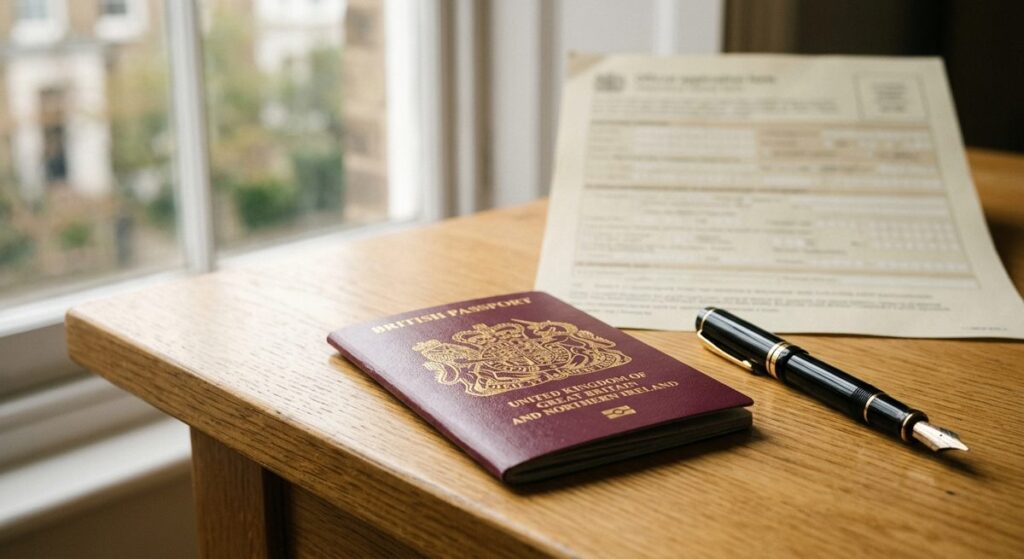
A British citizen who moves abroad retains the right to return to the UK and live here at any time. British citizenship does not lapse through residence outside the United Kingdom, however long the absence lasts. It can end in only two ways, a voluntary renunciation or a deprivation order, and each follows a strict legal process under the British Nationality Act 1981. This post provides an overview of how British citizenship can and cannot be lost for a person living abroad.
Does living abroad affect your British citizenship?
Living abroad does not affect a person’s British citizenship. Citizenship is a legal status held under the British Nationality Act 1981, whether it was acquired at birth or by naturalisation, and it is not tied to where the citizen lives. A British citizen may spend any length of time outside the UK and remains a British citizen throughout.
Residence and absence rules are a requirement for before citizenship is granted, not after. An applicant for naturalisation must meet the residence requirements, which limit time spent outside the UK during the qualifying period. Once citizenship is granted, those limits no longer apply. A naturalised citizen who later moves abroad keeps the same status as a person who was born British.
Dual nationality does not change this position. The UK permits a British citizen to hold one or more other nationalities at the same time, as explained in the UK dual citizenship guide. Acquiring or holding a second nationality while living abroad does not, by itself, remove British citizenship.
How can a person give up British citizenship?
A person can give up British citizenship only by making a formal declaration of renunciation to the Home Office. Renunciation is a deliberate legal act, set out in section 12 of the British Nationality Act 1981. It does not happen automatically, and it does not happen by moving abroad or by taking another nationality.
The declaration is made on a prescribed form, and the Home Office registers it. A declaration is normally registered only where the person already holds, or is about to acquire, another citizenship or nationality. This condition exists so that renunciation does not leave the person stateless. GOV.UK sets out the process to give up British citizenship or nationality.
Renunciation can sometimes be reversed. A person who gave up British citizenship in order to keep or acquire another nationality may be able to resume it, in some cases on one occasion as of right. The conditions are specific, and the application is made on a separate registration form.
When can the Home Office deprive a person of British citizenship?
The Home Office can deprive a person of British citizenship in two defined situations under section 40 of the British Nationality Act 1981. The first is where the Secretary of State is satisfied that deprivation is conducive to the public good, and the person would not be left stateless as a result. The second is where citizenship was obtained by registration or naturalisation through fraud, false representation or concealment of a material fact.
Deprivation is made by an order, not by the passage of time, and the published deprivation of British citizenship caseworker guidance governs how each case is assessed. It is a rare measure that applies to a narrow set of circumstances. Living abroad is not a ground for deprivation.
Does the position differ for citizens by birth and by naturalisation?
The position is broadly the same for citizens by birth and by naturalisation, with one distinction on deprivation. Renunciation under section 12 is available to any British citizen, however the status was acquired. The right to return to the UK and live here applies equally to both groups.
The distinction concerns deprivation for fraud. Deprivation on the ground of fraud, false representation or concealment applies where citizenship was acquired by registration or naturalisation. A person who is British automatically, by birth or descent, did not acquire the status by application, so that particular ground does not arise. The conducive-to-the-public-good ground can, by contrast, apply regardless of how citizenship was acquired, subject to the bar on statelessness.
Can a British citizen living abroad pass citizenship to a child born overseas?
Whether a British citizen can pass citizenship to a child born overseas depends on whether the parent is British “by descent” or “otherwise than by descent”. This is the issue that most often affects families living abroad, and it turns on the parent’s category of citizenship rather than on where the parent lives.
A parent who is British otherwise than by descent generally passes citizenship automatically to a child born outside the UK. That category usually means a person who is British by birth, adoption or registration in the UK. The child acquires citizenship by descent. A parent who is themselves British by descent generally cannot pass citizenship automatically to a child born abroad. GOV.UK explains who can apply for citizenship through a British parent, including the limited Crown service exception.
A registration route may still be available where automatic transmission does not apply. A child in this position can sometimes be registered as a British citizen, and the registration routes for children set out when each applies. The route depends on the child’s circumstances and, in some cases, on the family later living in the UK.
Does living abroad affect the right to return to the UK?
Living abroad does not affect a British citizen’s right to enter and live in the UK. British citizens hold the right of abode, which is the right to come to the UK without immigration restriction and to remain for as long as they wish. The right of abode continues throughout any period spent overseas.
A British passport is evidence of citizenship rather than the citizenship itself. A passport can expire while the citizen lives abroad, and an expired passport does not end citizenship. The holder can renew the passport from overseas in order to travel and to continue evidencing status. The wider benefits of British citizenship, including the right of abode and freedom from immigration control, remain available to a citizen who lives outside the UK.
Frequently asked questions
No. British citizenship does not expire through absence from the UK, regardless of how many years pass. It is a status held under the British Nationality Act 1981 and is not conditional on residence. The right to return to the UK and live here continues for as long as citizenship is held.
Yes. The UK allows a British citizen to hold one or more other nationalities at the same time. Acquiring or holding another nationality while living abroad does not remove British citizenship. Whether the other country permits dual nationality is a matter for that country’s own law.
In some cases, yes. A person who renounced British citizenship in order to keep or acquire another nationality may be able to resume it, in certain cases on one occasion as of right. The conditions are specific, and a separate registration application is required.
It depends on the parent’s status. A parent who is British otherwise than by descent usually passes citizenship automatically to a child born abroad. A parent who is British by descent usually cannot, although a registration route may be available depending on the child’s circumstances.
How Whytecroft Ford can help
The Whytecroft Ford immigration team advises on British citizenship and nationality matters, including the registration of children, the resumption of citizenship after renunciation, and confirmation of status. The firm reviews each family’s history against the British Nationality Act 1981 before an application is prepared. This is particularly useful for the British citizen building a life overseas who wants certainty about the status of a child born abroad.
To discuss your nationality position with our team, call 0208 757 5751 or use the contact form.
Sources
- Give up (renounce) British citizenship or nationality – GOV.UK
- Deprivation of British citizenship: caseworker guidance – GOV.UK
- Apply for citizenship if you have a British parent – GOV.UK
Written and reviewed by the Whytecroft Ford immigration team. IAA Accredited. All guidance is researched against primary sources, including the British Nationality Act 1981, Home Office caseworker guidance and GOV.UK. Reviewed every six months, or sooner following a rule change.